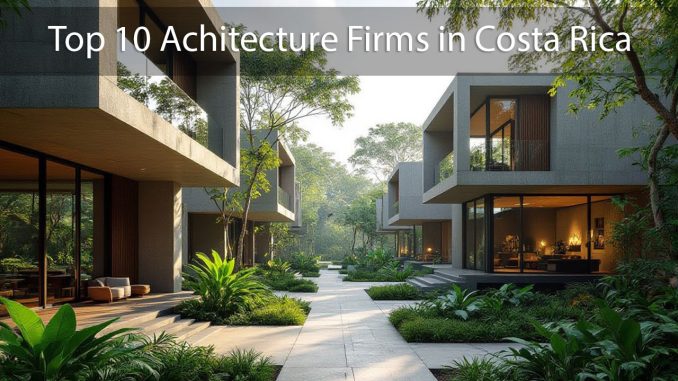
There’s a wealth of architectural talent in Costa Rica to help you realize your construction goals, offering expertise in sustainable design, site-sensitive planning, and local-materials integration; this guide highlights ten leading firms so you can confidently select a partner that aligns with your budget, aesthetic, and environmental priorities, and navigate permitting, design, and construction with informed clarity.
Zalez Architecture
Zalez blends artisanal detail with modern systems so you get spaces that feel rooted in Costa Rica while performing to contemporary standards. You benefit from site-driven layouts that orient for prevailing breezes, locally sourced hardwoods and volcanic stone, and transparent schedules and budgets from schematic design through construction supervision.
Unique Design Philosophy
You encounter an “architecture with soul” approach that translates your routines into spatial sequences, prioritizes minimal footprint, and uses passive strategies like cross-ventilation and daylighting studies. Material palettes favor local timber and low-embodied-energy finishes, and every plan is tailored to the specific topography and microclimate of your site.
Signature Project Highlights
Portfolio highlights span custom residences, boutique hospitality conversions, and mixed-use retail fit-outs. One beachfront residence eliminated mechanical cooling for most months through elevated slabs and optimized airflow, while an urban retrofit converted a colonial shell into six revenue-generating suites, retaining original timber beams.
For each highlighted project you can expect end-to-end coordination: permitting, structural engineering collaboration, phased budgeting, and on-site quality assurance. The studio pairs CNC-fabricated components with local craftsmen to speed construction without sacrificing bespoke joinery and finish details that define your project.
Salvaje Studio
You’ll find Salvaje Studio framing buildings as extensions of the landscape, favoring elevated platforms, open-air living and deep eaves to maximize cross-ventilation and daylight. Their projects commonly pair local hardwoods and bamboo with concrete plinths, specify solar PV and rainwater-harvesting systems, and minimize cleared footprints by preserving mature trees and natural drainage—approaches that reduce energy use and integrate your home directly into Costa Rica’s rainforest and coastal ecosystems.
Sustainable Architecture Practices
Salvaje prioritizes passive strategies first: cross-ventilation, shading with 1.2–2.5 m overhangs, and orientation to prevailing trade winds, then supplements with active systems like rooftop PV arrays and modular rainwater tanks. You’ll notice they limit impermeable surfaces, use natural ventilation to cut mechanical cooling loads, and specify locally milled timber and low-VOC finishes to reduce embodied carbon and support regional supply chains.
Integrating Local Aesthetics
Design language draws from Costa Rica’s colonial and indigenous heritage through hand-glazed terracotta tiles, woven textile patterns, and carved Guanacaste details, balanced against modern, minimalist volumes. You’ll see verandas and internal courtyards that echo traditional proportional systems, polished concrete floors paired with vibrant native-color palettes, and custom joinery made by local artisans to give each project a distinct cultural resonance.
To achieve authentic integration, Salvaje often runs collaborative workshops with local carpenters and ceramists to translate vernacular motifs into contemporary elements—louvered screens inspired by pre-Colombian geometry, reclaimed wood beams reworked into furniture, and native-plant palettes for low-water landscaping. This process preserves craft techniques, shortens supply chains, and ensures the finished building reads as both of-place and modern, aligning material choices, texture, and scale with the surrounding bioregion.
CRN Architecture
Architectural Trends and Innovations
CRN synthesizes modern minimalism with tropical responsiveness: you’ll notice deep overhangs, floor‑to‑ceiling glazing oriented to prevailing winds, and operable screens that enable passive cooling. They prioritize minimizing building footprint through compact, stacked programs and use of locally sourced materials alongside rainwater harvesting, solar PV and natural ventilation strategies. Their detailing leans toward exposed concrete and native hardwoods, producing durable, low‑maintenance structures suited to coastal climates while delivering bold, clean‑lined aesthetics.
Noteworthy Commissions and Projects
You’ll find CRN’s portfolio concentrated in Santa Teresa, Nosara, Tamarindo and Guanacaste, spanning boutique hospitality, private beachfront villas and mixed‑use commercial buildings. They often handle projects from schematic design through construction, blending site‑responsive floor plans with integrated sustainable systems like rainwater capture and rooftop solar. Clients hire them for complex coastal sites where erosion control, local permitting and contractor coordination demand on‑the‑ground expertise.
On a typical beachfront commission you can expect open‑plan living oriented to ocean views, elevated slabs or stilts to address flood risk, extensive shading devices, and material palettes tuned for salt‑air durability; CRN coordinates structural engineers, local builders and environmental studies to streamline approvals and keep budgets aligned, giving you a single point of accountability from design through handover.
Aarcano Arquitectura
AARCANO, led by Esteban Castro and Carla Carranza, treats cultural memory as a design driver: you’ll notice projects that use locally sourced timber, passive ventilation, and rainwater-harvesting courtyards to stitch contemporary volumes into existing urban and rural fabrics. Their research-led practice reduces footprint while enhancing daylight, thermal comfort and spatial sequence so your building reads as both an inheritance and a contemporary intervention.
Blending Tradition with Modernity
Pairing Spanish-colonial elements—deep verandas and high ceilings—with clean modern geometry, AARCANO applies strategies like overhangs, cross-ventilation and local volcanic stone alongside minimalist concrete and steel; you get heritage proportions with improved energy performance, lower maintenance and a clear visual dialogue between past and present.
Community-Centric Projects
AARCANO runs participatory charrettes and co-design sessions that shape schools, plazas and small civic buildings, transforming community input into features such as shaded terraces, modular classrooms and rainwater-fed gardens so your project supports daily social life as well as aesthetic goals.
Projects are often executed in phases to maintain services, employ local artisans for carpentry and masonry to strengthen the local economy, and include maintenance guides and post-occupancy surveys AARCANO conducts to verify performance; you’ll gain resilient, low-tech solutions—bioswales, solar-ready roofs and durable joinery—backed by follow-up adjustments based on real user feedback.
StudioDelRio
StudioDelRio blends sculptural form with practical living so you get spaces that both perform and delight; you’ll find designs that minimize footprint, use local hardwoods and prefabricated elements, and integrate rainwater harvesting, photovoltaic-ready roofs and passive ventilation to meet your program, site and budget without sacrificing aesthetic refinement.
Notable Techniques and Materials
You’ll see StudioDelRio favor compressed stabilized earth blocks and locally milled teak for shading and finishes, concrete mixes with up to 20% fly ash to lower embodied carbon, prefabricated timber modules that cut site time by roughly 30%, and double‑skin facades plus wide eaves to reduce cooling loads and reliance on mechanical systems.
Case Studies on Innovative Builds
Several built projects demonstrate how their methods translate to measurable outcomes: compact 260 m² homes delivering 35–45% lower cooling energy, coastal pavilions capturing enough rainwater to supply 40–60% of annual domestic demand, and modular retreats erected in 12–16 weeks to meet tight timelines and budgets.
- Casa Río — 260 m² (2,800 ft²); construction 14 weeks; budget $420,000; 42% reduction in cooling energy via cross‑ventilation and shading.
- Montaña Retreat — 180 m² (1,940 ft²); on‑site CSEB walls (60% local material); 55,000 L annual rainwater capture; 30% shorter schedule using prefabricated roof modules.
- Coastal Pavilion — 120 m² (1,290 ft²); elevated design for storm resilience; 40% of hot‑water demand met with rooftop solar thermal; foundation costs reduced 18% through lightweight timber framing.
Project metrics consistently show how design choices affect performance and cost: you can compare embodied material percentages, construction durations and operational savings to select approaches that match your priorities—whether that’s upfront budget, speed to occupancy, or long‑term energy and water independence.
- Performance House A — 300 m²; embodied carbon cut ~12% by substituting 20% fly ash in concrete; estimated operational energy 38 kWh/m²/year.
- Raincatch Collective — multi‑unit cluster 4×80 m² units; shared cistern 220,000 L supplying 60% of non‑potable use; payback on rainwater system ~6 years.
- Rapid Shelter Prototype — 90 m² modular unit; complete assembly in 12 days on site; total delivered cost $95,000 per unit (incl. finishes); targeted for remote‑access builds.
VOID
Experimental Designs and Structures
Since 2012, VOID—headed by Sergio Frugone, Felipe Rossi and Ricardo Sevilla—pushes you beyond conventional forms through multidisciplinary collaboration; expect explorations in negative space, bold volumetrics and material juxtaposition that prioritize both aesthetics and function, producing public and private schemes where perforated facades, layered terraces and strategic voids enhance daylighting and cross-ventilation while keeping footprints minimal.
Impact of Contextual Awareness
VOID frames each project to actively shape its immediate context, so you receive designs that respond to topography, community patterns and microclimate; the office frequently coordinates with landscape and engineering teams to align massing, circulation and sightlines, using locally sourced finishes to strengthen cultural and environmental fit.
In practice you’ll notice orientation choices that capture prevailing winds, deep overhangs and operable facades to reduce cooling loads, plus provisions for rainwater harvesting and solar-ready roofs—measures that lower operational energy, preserve existing vegetation and demonstrate tangible sensitivity to neighboring ecosystems and urban fabric.
Carazo Arquitectura
Since Rodrigo Carazo founded the San José office in 2005, Carazo Arquitectura has emphasized designs that respect site context and climate; you’ll find projects that minimize footprint, prioritize locally sourced materials, and layer passive strategies like natural ventilation and solar readiness to suit Costa Rica’s varied environments.
Integrated Design Strategies
Carazo aligns architecture, structure and landscape early so your project performs as a system: orientation and cross-ventilation are coordinated with roof and façade decisions, rainwater harvesting is integrated into grading and irrigation plans, and MEP routing is resolved during schematic design to reduce on-site changes.
Client Testimonials and Success Stories
Clients note clear communication, reliable scheduling and site-sensitive solutions; you’ll see feedback describing how a San José residence retained mature trees while adding a low-energy wing, and how commercial clients praised improved comfort after passive retrofits.
You’ll often learn specifics from those testimonials—timelines met, permit coordination handled, and measurable reductions in operational needs—use these examples to gauge how Carazo manages costs, construction oversight and long-term performance for your project.
A-01 (A Company / A Foundation)
A-01 operates as an interdisciplinary network that blends designers, engineers, economists and social scientists to co-create projects at the city–countryside edge. You benefit from their 4E framework—Economy, Engineering, Environment, Equity—used to design participatory masterplans, watershed-restoration pilots and peri-urban housing strategies that prioritize minimized footprints, local materials and integrated technical feasibility from day one.
Community and Philanthropic Contributions
You’ll find A-01 running community co-design workshops and capacity-building programs that train local builders in low-impact techniques and project governance. Their philanthropic initiatives often fund seed studies, participatory mapping and small-scale infrastructure pilots so communities retain ownership while demonstrating scalable social and environmental returns.
Vision for Future Developments
A-01 plans to scale pilot interventions into municipal policy by proving replicable models for circular-material construction, decentralized water systems and mixed-use green corridors. Their long-term focus is translating site-specific co-design outcomes into regional frameworks that balance economic growth with equitable resource stewardship.
More specifically, you can expect A-01 to pair life-cycle cost modelling with nature-based solutions: microgrids, rainwater-harvesting, passive ventilation and modular low-carbon assemblies. This tactical mix ties the 4E metrics to measurable targets—reduced embodied carbon, lower operating costs, and inclusive governance—so your project delivers both technical performance and social impact.
Salagnac Arquitectos
Salagnac Arquitectos blends contemporary tropical principles with bioclimatic strategies so your project sits lightly on the landscape while delivering comfort. You’ll see designs that prioritize cross-ventilation, deep overhangs, and locally sourced materials so interior temperatures drop without heavy mechanical cooling. Their approach balances technology and craft to reduce operational loads and preserve site character, helping your build perform efficiently in Costa Rica’s varied microclimates.
Historic Preservation and Modern Adaptation
Salagnac often rehabilitates colonial and mid-century structures by retaining original timber, clay tiles and masonry while inserting discreet seismic reinforcement and insulation so you keep historic patina without sacrificing safety or comfort. Retrofit tactics include upgraded structural ties, breathable waterproofing, and passive cooling interventions that commonly lower annual cooling demand by roughly 30% compared with unadapted equivalents.
Landmark Projects and Achievements
You’ll find Salagnac’s portfolio spans coastal villas, community centers and urban infill across Guanacaste, Central Valley and the Southern Pacific, with many projects demonstrating measurable sustainability gains. Typical outcomes include 30–45% reductions in cooling loads, integrated photovoltaic systems offsetting a substantial portion of electricity use, and rainwater harvesting systems meeting a large share of nonpotable demand.
In practice, their landmark commissions pair site-specific strategies—elevated footprints, expansive shaded verandas and orientation for prevailing winds—with systems engineering: PV arrays commonly sized in the 10–25 kW range, rainwater cisterns from 30–80 m³, and targeted envelope upgrades. These combined measures routinely yield 40–60% reductions in operational energy and water intensity, outcomes you can track through post-occupancy monitoring and performance reports.
Studio Saxe
Studio Saxe, founded by Benjamin Garcia Saxe in 2004, blends technological innovation with handcrafted techniques so your project connects to its landscape; the award-winning, multidisciplinary practice integrates passive cooling, solar shading, rainwater strategies and locally sourced materials to reduce energy use and sit lightly on site while maximizing views and indoor‑outdoor living.
Environments That Enhance Lives
You experience spaces that prioritize cross‑ventilation, shaded terraces and courtyards to extend living areas outdoors; by combining wide eaves, native timber finishes and simple structural systems Studio Saxe helps your home stay comfortable in Costa Rica’s humid climate while lowering operational costs and preserving the surrounding ecology.
Innovative Use of Space and Light
You benefit from layered volumes, clerestories and light wells that bring diffuse daylight deep into interiors; Studio Saxe arranges double‑height voids and screened facades so your rooms feel larger, daylight replaces daytime artificial lighting, and glare and heat are carefully controlled.
For your project, expect operable louvers, perforated screens and oriented courtyards that modulate sun and breeze throughout the day; this choreography of elements lets you tune privacy, daylight and ventilation seasonally, producing resilient, low‑energy interiors without sacrificing spatial drama.
Summing Up
With this in mind, when choosing among Costa Rica’s top ten architecture firms you should prioritize local experience, sustainable design credentials, and clear communication to align your budget and vision. Review portfolios, verify technical and permitting expertise, and seek references to ensure the firm will protect your site and optimize climate-responsive solutions. By focusing on fit and track record, you’ll increase the odds your project succeeds.